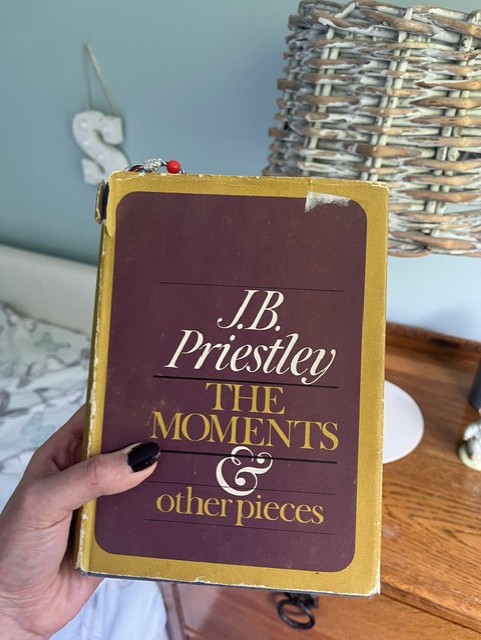
J.B Priestley’s 1961 collection of essays, The Moments and Other Pieces, is not the usual type of book that I would read for fun. I bought the antique book in a second-hand bookshop in Belfast last summer and read a couple of months ago, as I wanted something intellectual to read to engage my brain with. I only knew of Priestley from studying his most well-known work, An Inspector Calls, for GCSE English Literature, which was my favourite text that I can remember studying at secondary school. Analysing the play’s dramatic twist and socialist message demonstrated the extent of the power that literature could wield to fourteen-year-old me.
John Boynton Priestley was born in the West Yorkshire city of Bradford in 1894. After serving as a soldier during the First World War, he enrolled at the University of Cambridge in 1919 to study English Literature. He then moved to London where he embarked on a career as a writer whose work took the form of plays, novels and essays. A lot of Priestely’s work, such as An Inspector Calls, was influenced by Priestley’s socialist views and anger towards the social inequalities that existed in 1930s Britain. Unemployment was at all-time high, as traditional industries such as coal-mining and shipbuilding suffered greatly during the Great Depression, caused by the 1929 Wall Street Crash in America. Millions of people in Northern England and Wales lived in extreme poverty, while the economies in areas such as the Midlands and South-East England flourished due to the emergence of new, lighter industries such as the motor vehicles and electronic goods. It was these socialist views that cost Priestley his broadcasting career at the BBC. During the Second World War, he presented the Sunday night radio programme, Postscript, in which he celebrated everyday British life. He proved to be extremely popular and especially appealed to the working-classes. However, comments such as there not being “too rich and too great a reward” owed to working-class people after the war (Hendy, 2022, p. 198) was seen as a left-wing threat by senior Conservative politicians, including Prime Minister Winston Churchill himself. After the political party protested to the BBC, Priestley was removed from Postscript after his first series. Nevertheless, Priestley continued to write where he shared his views in various publications. Twenty-six of his essays and four of his lectures are collected in The Moments…, which he published in 1961 as a gift to Oxfam. His writings capture the zeitgeist of the post-war era as people had to adjust to a world that would never be the same after the largest and deadliest conflict of all time.
Priestley makes a lot of references to the nuclear arms race in The Moments. The end of the Second World War in 1945 prompted a period of extreme tension between the USA and the Soviet Union, as the two super-powers competed against each other to assert their dominance by developing the largest collection of nuclear weapons. As a close ally to the USA, Britain officially entered the arms race in 1952 when they successfully tested an atomic bomb and therefore became the world’s third nuclear power. Priestley famously shared his anti-nuclear views in a 1957 article in the New Statesman, which attracted mass public attention and led to the founding of the Campaign for Nuclear Disarmament the following year. In one of the essays in The Moments, named “Dark Junction”, Priestley describes the Government’s spending on a nuclear submarine as a waste of money that could have been better spent on public spending as, if it was ever to be used, nobody would “be here to learn if the submarine is doing any good or not” (p. 23). These fears are more relevant than ever in the global political climate in 2026.
Sixty years on from the publication of The Moments, it is remarkable to notice how Priestley was so ahead of his time. Many of his predictions about society have since materialised and are now the biggest issues in the world today. He noticed the negative effects that television advertising started to have upon young people’s mental health, as despite being persuaded to buy “all the right clothes… ready for superb Casual Living” they failed to find themselves “in the Happy Land” (p.52). He would be horrified if he had lived to see the invention of social media.
Priestley also discussed the topic of eroticism, which he defined as “sexual pleasure without sexual responsibility” (p. 101). He had already been married three times before the sexual revolution in the 1960s, when social attitudes to sex and relationships began to become more liberal. This gradual shift in values was marked by various events such the development of the contraceptive pill; the second wave of feminism and the rise of alternative subcultures. In the “Eroticism, Sex and Love” essay, Priestley warned us about the sexualised images of women that began to be printed on paperback novels in the 1960s as an example of the “the encouragement and exploitation of eroticism, sometimes out of hatred of Woman, fear of real sex and love; but mostly for commercial gain” (p. 103) that was corrupting society. God knows what he would think of OnlyFans in 2026! In this essay, I was very surprised to read Priestley discuss modern ideas about the fluidity of gender as he claimed that “most of us have an element, to a differing degree, of the opposite sex in us” (p. 110). I really did not expect such progressive views from man born in the Victorian period, when some of our politicians today still can’t understand that gender is a spectrum that every individual has the right to express freely.
Priestely was also concerned about the post-war technology advancements, particularly the rise of television. Although the first television was invented by John Logie Baird back in 1926, very few people owned one. The BBC suspended all television broadcasting during the entirety of the Second World War, and it did not resume until 1946. During the post-war period, Britain enjoyed an economic boom which saw a huge increase in working-class people’s wages. More people could therefore afford consumer goods that were previously only available to the wealthiest people. By 1960, three quarters of British households owned a television (Goodhart, The Guardian, 2022). In a 1961 lecture “What about the Audience?”, published in The Moments, Priestley discusses the effects that this new medium may have upon society. He defends the traditional art of theatre as it forces the audience to be “not passive but active… Even say creative” (p. 255). This is very interesting in consideration of current discussions about the influence that AI has upon the arts.
There were some essays in The Moments that covered boring topics that are not as relevant to the modern reader, such as how Priestley loved smoking tobacco. I found myself skimming over these sections. However, they do not take away from how ahead of his time Priestley was. I’m so glad I picked this book up in that second-hand bookshop in Belfast.
References
- Boynton Priestley, J. (1966). The Moments [Review of The Moments]. Heinemann.
- Goodhart, B. (2022, February 16). ‘At 6pm every evening the screen went blank’: The outlandish tale of the UK’s TV blackout. The Guardian. https://www.theguardian.com/tv-and-radio/2022/feb/16/at-6pm-every-evening-the-screen-went-blank-the-outlandish-tale-of-the-uks-tv-blackout
- Hendy, D. (2022). The BBC: A People’s History. Profile Books.

 Simone Reddington
Leave a comment