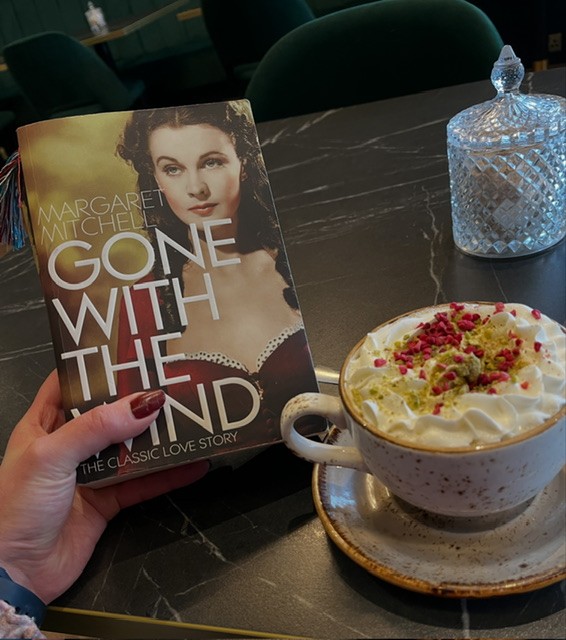
Gone with the Wind is a book that I have wanted to read since I was a young child, and I finally read it this year. My maternal grandmother (who was born just three years after the novel’s original 1936 publication) has often described it as one of her favourite books of all time, and it is often hailed an American classic. Set in the southern US state of Georgia during the American Civil War, Margaret Mitchell’s historical epic novel is nearly one thousand pages long and took me nearly two months to finish, despite my determination to read at least one chapter per day.
The narrative takes place over a twelve-year period from 1861, starting just before the outbreak of war and follows the characters through the Reconstruction era; when the North and South had to navigate rebuilding relations and restore the country after the Civil War ended in 1865. The novel’s protagonist is Scarlet O’Hara, the attractive but selfish daughter of a well-respected plantation owner. She is introduced at the beginning of the narrative as a teenage girl who is more concerned with flirting with boys than worrying about the talk of political conflict. Over the course of the novel, she matures into a woman who takes it upon herself to rebuild her family’s wealth. She marries three times, but her heart secretly belongs to her bookish childhood sweetheart, Ashley Wilkes, who is married to her sister-in-law. The only character who knows about her feelings towards Ashley is Rhett Butler, whose refusal to submit to social etiquette earns him a scandalous reputation, and he teases her mercilessly for it. Scarlet and Rhett’s tempestuous relationship takes many turns throughout the novel, as Scarlet discovers that she has more in common with him than anyone else as she is also no longer afraid of what other people would say about her; so long as she gets what she wants.
My expectation of Gone with the Wind was that it would be a heartwarming love story, as I knew that the 1939 film adaptation (which I provided both Vivian Leigh and Clark Gable with Oscar nominations for their depiction of Scarlet O’Hara and Rhett Butler’s passionate relationship. However, the book is actually very dark and has aged very poorly in the ninety years since its publication. It is an extremely racist novel that accurately reflects the systemic prejudices that existed in America during the era in which the novel is set. I felt very uncomfortable reading the many offensive racial slurs, used both within the characters’ dialogue and in Mitchells’ third-person, omniscient narrative. Slavery is romanticised throughout the novel, as all the characters took the side of the Confederacy during the war, who fought for their right to own slaves. It is very clear that Scarlet and her peers do not see view black people as equal to them, even after their slaves are freed, and they even show sympathy towards the Klu Klux Klan. There was not a single character in the book whom I liked and could remotely align myself with their values.
However, this is not surprising as racism was still deeply ingrained in American society when Mitchell published Gone with the Wind in 1936; especially in the Deep South states such as Georgia. Slavery may have been abolished in all US states under the 1865 Thirteenth Amendment and African American men were granted the right to vote five years later, but various racial segregation laws were then put in place. Often referred to as ‘Jim Crow laws’, they were imposed by individual states and local authorities. They prevented black people from using the same public facilities as white people, thus creating huge social and economic differences between the races. The last of these laws was not repealed until 1965, a century after the Civil War, when the Voting Rights Act banned all racial restrictions on voting.
Despite her offensive views and incredibly selfish nature, I couldn’t help but find myself liking Scarlet as I read the novel. I found her admission of not caring at all about the Confederacy cause absolutely hilarious, as she sulked about not being able to dance at balls as a war widow. I also admired how she refused to allow her gender in the nineteenth century to prevent her from developing shrewd business skills as she rebuilds her family plantation by herself. The novel also contains a lot of internalised misogyny as the female characters, including Scarlet herself initially, did not think that it was appropriate for women to take any interest in business or politics. However, with the absence of most men during the war, many women had to fill their spaces in the workplace
Gone with the Wind turns ninety years old this year and it is still celebrated a classic in American literature. Society may have evolved from slavery and racial segregation, but it is still vitally important to remember how these changes were implemented. Although Margaret Mitchell’s historical novel isn’t pleasant, it is an accurate depiction of how the people of America were forced to adapt to war and the emergence of a new society in the years following it. It serves as a fictional archive of a pivotal era in American history.


 Simone Reddington
Leave a comment