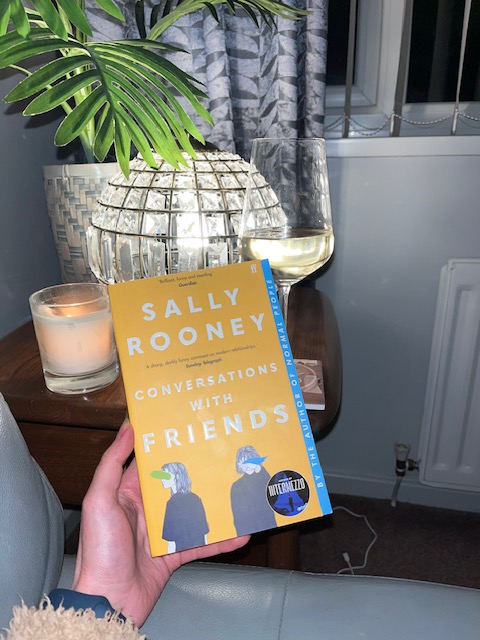
I rarely buy myself brand new books as I normally find a wealth second-hand gems in charity shops, but I recently treated myself to Conversations with Friends as a Christmas present to myself. The novel is the 2017 debut of Sally Rooney, who has since established herself as one of the most well-known contemporary fiction authors in the twenty-first century. Her success is largely due to the popularity of her later novel Normal People, which was adapted into a BBC television mini-series that became the broadcaster’s most highly streamed programmes during the COVID-19 pandemic. Like many others, I devoured Normal People during that hot summer in 2020 when we weren’t allowed to do much else apart from reading and fell in love with Rooney’s beautiful and intelligent writing style. Five years later, I fell in love with her writing all over again as I soaked up every word of Conversations with Friends during the dark, cold days of January.
Born in Ireland’s County Mayo in 1991, Sally Rooney has been referred to as “the first great millennial author” by the New York Times as her work reflects the lives of professional young people in the world today. Her characters are typically university-educated with liberal political mindsets but have failed to secure the high-flying careers and place on the property ladder promised by previous generations. Her books typically centre around relationships but are more complex than to be labelled as romance novels. Without giving away any spoilers, neither of the two books of hers that I have read contain a conventional ‘happy ending’, where the two central characters commit to a positive, stable relationship by end of the story. The relationships between the characters in Rooney’s novels are complex because she writes a lot about mental health when creating her narratives. The focus is therefore on exploring the characters’ traumas, rather than anticipating a resolution to their messy love lives. The role of the internet and digital technology in modern society is also represented in Rooney’s work, as she often depicts her characters communicating with each other online. This lack of direct face-to-face contact often leads to a lack of clear communication between the characters, thus highlighting the complications in modern relationships and dating.
The central protagonist and narrator in Conversations with Friends is Frances, a twenty-one year old student at Dublin’s Trinity College. She is a talented writer and performs spoken word with her best friend and ex-girlfriend Bobbi. Bobbi is a lot more confident and outspoken than Frances, who appears to live in her best friend’s shadow. When the two girls befriend a married middle-class couple, Melissa and Nick, they are introduced to glamourous world of dinner parties and holidays in Brittany. The complications in Melissa and Nick’s marriage are exposed to the readers when Nick and Frances embark upon an extra-marital affair. They are both completely unsure about how to navigate their feelings towards each other, or how their relationship affects the people around them.
The plot of the novel is very slow paced, which may be off-putting for some readers. There are no dramatic climaxes, and the story ends on a cliffhanger. I feel that the lack of a satisfying conclusion in Conversations with Friends is a perfect reflection on Frances’ psyche throughout the bildungroman novel. It is very clear to the reader that Frances feels very lost in the world that she inhabits, which is completely normal for a young woman of her age. She is evidently a lot less experienced in sex and relationships than Nick and often uses her sharp wit to defect from her romantic feelings. The relationship forces her to evaluate how she views herself and the relationships with her friends and family. The novel’s slow pace allows Rooney to interpret various social themes; such as identity, class, disability and religion; into the narrative so that the reader could have a better understanding of the characters’ attitudes and behaviours.
Although I really enjoyed reading Conversations with Friends, I did find myself disliking all four of the novel’s central characters, as they are all very flawed which made them very believable. I found Frances and Bobbi particularly insufferable, but their imperfect relationship did remind me of complicated friendships that I had when I was younger. The book truly is an honest depiction of being in your early twenties and being completely uncertain about yourself and the crazy world around you.



 Simone Reddington
Leave a comment